
Analysis
Based on the Ninth Circuit’s directly applicable 2026 ruling in Howard v. Republican National Committee, six additional federal court decisions, an FCC declaratory ruling governing human-initiated peer-to-peer texting, and a technical assessment of how non-autoplay video is delivered and rendered within MMS.
MMS video technology delivers a silent multimedia communication—not a prerecorded voice—and any audible content plays only after the recipient makes a separate, affirmative choice to initiate playback. Where the message is human-initiated and the video does not autoplay, existing federal legal authority and the underlying technology strongly support its lawful use under the TCPA.
Executive Opinion
A case study of Peerly’s Video in Motion[34] shows that a video individually initiated through a peer-to-peer texting platform—which arrives silently as an MMS/video thumbnail, does not autoplay, and requires the recipient to affirmatively press play—should not constitute a telephone call made or initiated “using” an artificial or prerecorded voice under the federal Telephone Consumer Protection Act (“TCPA”).[1][2]
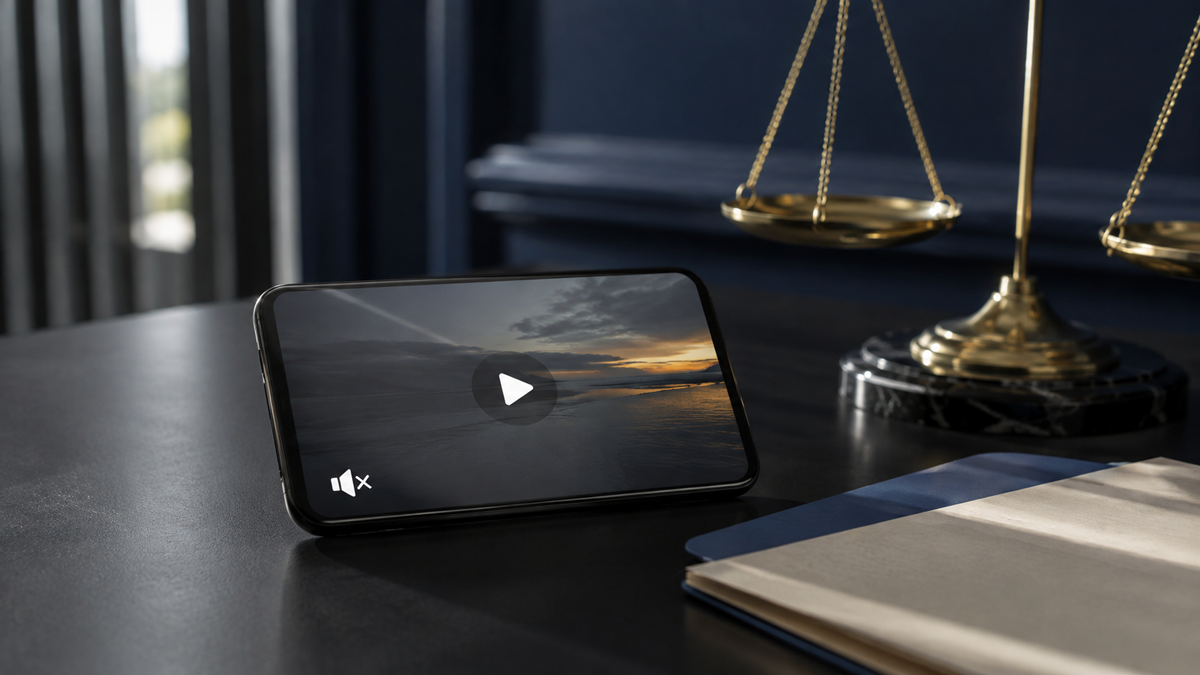
During the final weeks of the 2020 presidential election campaign, the Republican National Committee (“RNC”) sent an Arizona voter a political text message accompanied by a video relaying a message from Ivanka Trump, daughter of President Donald Trump. The video automatically downloaded to the recipient’s phone and appeared directly above the text as a still-image thumbnail of Ivanka Trump with a play button over it. The recipient alleged that the video contained an artificial or prerecorded voice and that he had not consented to receiving it. Importantly, however, the video did not autoplay. The recipient had to tap the thumbnail or play button before hearing anything.[3]
The Ninth Circuit affirmed dismissal of the TCPA action. The court held that the relevant statutory provisions address the use of artificial or prerecorded voice in the manner in which a communication is made or initiated. Because the RNC’s communication began through textual content and the silent presence of a video file—and because the recipient had to affirmatively choose to play the video—the communication was not made or initiated using a prerecorded voice.[4]
For Video in Motion, this is exceptionally significant. Howard was not a hypothetical technology case or a generic commercial SMS dispute. It involved political voter outreach by the RNC during a presidential election, a political video featuring Ivanka Trump delivered within a text message, automatic download of the video, a still-image thumbnail with a play button, and a requirement that the voter affirmatively press play before hearing the prerecorded voice.[5]
The Critical Legal Distinction: Delivery Is Not Playback
The TCPA does not prohibit a communication merely because a digital file associated with it contains recorded speech. The relevant provisions prohibit making or initiating certain calls “using” an artificial or prerecorded voice.[6]
That distinction is critical.
The Ninth Circuit expressly recognized in Howard that the text message and accompanying video file included an artificial or prerecorded voice. Nevertheless, it held that the RNC did not use that voice to make or initiate the communication. The initial contact consisted of textual content and the “silent inclusion of a ready-to-play video file.” The recipient could hear the prerecorded voice only after independently choosing to tap the thumbnail and play the file. The court characterized that voluntary engagement as a “necessary intervening action” between the RNC’s initial contact and playback of the recorded voice.[7]
That produces the cleanest legal characterization of Video in Motion:
The sender initiates a silent multimedia text communication. The recipient independently initiates audiovisual playback.
The recipient’s subsequent decision to press play does not retroactively transform the original communication into one that was made or initiated using a prerecorded voice. That is the central holding and logic of Howard.[8]
The “Conscious Choice” Rule Developed Before the Ninth Circuit Appeal
The 2026 appellate decision in Howard was not an isolated development. It followed a consistent progression of TCPA decisions.
In Trim v. Reward Zone USA LLC, 76 F.4th 1157 (9th Cir. 2023), the Ninth Circuit considered whether ordinary written text messages themselves constituted an artificial or prerecorded “voice.” The court held that Congress used “voice” to refer to audible sound, not written expression. The Ninth Circuit specifically observed that an MMS could present a different question because an MMS is capable of including actual audio.[9]
Only months later, the United States District Court for the District of Arizona applied Trim directly to the MMS/video issue in Howard v. Republican National Committee, No. CV-23-00993-PHX-SPL, 2023 WL 7301861 (D. Ariz. Nov. 6, 2023). The court emphasized that although the video downloaded onto the recipient’s phone, the recipient still had to actively press play. The recipient therefore retained a “conscious choice” whether to engage with the audible component. The district court dismissed the prerecorded-voice claim.[10]
On the same day, the same court reached substantially the same result in Crawford v. National Rifle Association of America, No. CV-23-00903-PHX-SPL, 2023 WL 7301864 (D. Ariz. Nov. 6, 2023), another political messaging case involving a video with prerecorded audio that required recipient interaction before the audio could be heard.[11]
The progression is therefore significant:
2023 — Trim, Ninth Circuit: “Voice” under this TCPA provision requires an audible component.
2023 — Howard, District of Arizona: An MMS/video that requires the recipient to consciously press play does not establish a prerecorded-voice violation.
2023 — Crawford, District of Arizona: The same reasoning is applied in another political MMS/video matter.
2026 — Howard, Ninth Circuit: The appellate court affirms and sharpens the rule: although the video contained prerecorded speech, that voice was not used to make or initiate the call, because recipient playback was a separate intervening act.[12]
The Technical Architecture Supports the Same Conclusion
The engineering mechanics reinforce the court’s legal analysis.
A video delivered through MMS is a digital multimedia asset. In Howard, the Ninth Circuit specifically recognized that the video file had automatically downloaded to the phone. Nevertheless, what the recipient initially encountered was a still-image thumbnail with a play button, and no prerecorded voice played automatically.[13]
A thumbnail is itself a visual representation of video content. Indeed, Howard cited United States v. Arce, 49 F.4th 382, 388 n.4 (4th Cir. 2022) for the technical proposition that a thumbnail is a reduced-size representation of a video frame. It also cited United States v. Frommelt, 971 F.3d 823, 828 (8th Cir. 2020) as an example of a video delivered through electronic messaging that appeared as a thumbnail with a play button and began playing only after the recipient clicked it.[14]
Modern audiovisual software likewise treats a media asset as a container capable of holding distinct types of media. Apple’s AVFoundation documentation, for example, describes an AVAsset as a container containing one or more media tracks, with audio and video among the most common separate track types.[15]
Accordingly, the strongest technical argument does not depend upon asserting that audio must travel through different network packets or exist in a physically separate file. Those details can vary by container format, codec, carrier implementation, and operating system and are unnecessary to the TCPA analysis.
The technical sequence is straightforward:
- Digital multimedia data is delivered to the device.
- The messaging interface presents silent visual content.
- The recipient affirmatively presses play.
- Only then is the audiovisual asset processed for playback and its encoded audio rendered as audible sound.[16]
- This architecture maps closely onto the Ninth Circuit’s legal reasoning. The existence of data capable of producing sound upon playback is not equivalent to using audible sound to make or initiate the communication.[17]
Additional Federal Appellate Authority Supports the “Use” Distinction
The Fifth Circuit provides additional appellate support for distinguishing the availability of prerecorded audio from its actual use. In Ybarra v. Dish Network, L.L.C., 807 F.3d 635 (5th Cir. 2015), DISH used equipment capable of playing prerecorded messages. The Fifth Circuit held that prerecorded-voice liability required the prerecorded voice actually to play; the fact that a recording was available to be triggered was insufficient where it never played. The court focused specifically on the statutory requirement that the communication be made “using” a prerecorded voice.[18]
Ybarra is not an MMS case and therefore does not independently decide the Video in Motion issue. But its statutory analysis reinforces the principle applied directly to video messaging in Howard: the presence or availability of prerecorded content is not necessarily the same as its use in making the communication.[19]
Peer-to-Peer Human Initiation Separately Addresses the ATDS Question
The TCPA’s Automatic Telephone Dialing System (“ATDS”) provision is a separate legal theory from the artificial/prerecorded-voice provision addressed in Howard.[20]
For purposes of this analysis, Video in Motion is assumed to operate through a peer-to-peer workflow in which a human affirmatively initiates each individual message. That fact is relevant to the ATDS analysis, although the precise capabilities of the underlying platform remain important.[21]
In its 2020 P2P Alliance Declaratory Ruling, the FCC explained that high messaging volume by itself does not determine whether equipment constitutes an autodialer. The FCC stated that where a platform is not capable of making calls or sending texts without a person actively and affirmatively manually initiating the required dialing/sending process, it is not an autodialer to the extent described in the ruling.[22]
The Supreme Court subsequently narrowed the ATDS definition in Facebook, Inc. v. Duguid, 592 U.S. 395 (2021). The Court held that qualifying equipment must have the statutory capacity involving a random or sequential number generator; the mere ability to store telephone numbers and automatically communicate with them is insufficient.[23]
The Ninth Circuit further applied Duguid in Borden v. eFinancial, LLC, 53 F.4th 1230 (9th Cir. 2022), concluding that the random-or-sequential-number-generator requirement concerns the generation of telephone numbers themselves, rather than merely generating numbers used to determine the order in which entries from a preexisting list will be contacted.[24]
The ATDS analysis should therefore remain technically separate from Howard. A Peer-to-peer deployment satisfies the human-initiation facts represented above and does not employ the random/sequential telephone-number-generation functionality required by Duguid and Borden. Therefore, this communication presents two separate and complementary characteristics:
A human initiates the text communication; and the communication itself is not initiated using an artificial or prerecorded voice.[25]
The sender transmits a silent multimedia message. The recipient sees written text and/or a thumbnail. Nothing speaks. Nothing autoplays. The recipient must make a separate voluntary decision before the recorded audiovisual material is rendered for playback.[26]
Conclusion - The legal and technical distinction is straightforward:
Video in Motion is a human-initiated multimedia text communication that silently delivers digital audiovisual content and gives the recipient the option to play that content. It is not, under the reasoning of Howard, a communication made or initiated using an artificial or prerecorded voice merely because the underlying video file contains recorded speech.[27]
The existence of encoded recorded speech inside the video file does not end the analysis. The Ninth Circuit confronted precisely that fact in Howard. The video had automatically downloaded onto the voter’s phone, contained prerecorded speech, and was visibly present within the text message. Yet because it appeared silently as a thumbnail and required the recipient to affirmatively press play, the majority held that the prerecorded voice was not among the means by which the RNC made or initiated the communication.[28]
That supports four particularly strong propositions:
- Delivery is not playback.
- The presence of encoded speech is not necessarily the statutory “use” of speech to make or initiate a call.
- A silent thumbnail is not itself an artificial or prerecorded voice.
- A recipient voluntarily pressing play after receiving a silent multimedia message does not retroactively transform the initial communication into one that was made or initiated using a prerecorded voice.[29]
For a non-autoplay Video in Motion architecture, Howard v. Republican National Committee is therefore not merely loosely analogous authority. It is an exceptionally close, recent, published federal appellate precedent involving political voter outreach by the RNC during a presidential election, a video relaying a message from Ivanka Trump, automatic download of the video file, a still-image thumbnail and play button, prerecorded speech within the video, and affirmative recipient action required before that speech could be heard.[30]
The Ninth Circuit nevertheless affirmed dismissal of the TCPA prerecorded-voice claims. The opinion was divided—Judge Rawlinson dissented—but the majority opinion is the published Ninth Circuit decision and is binding precedent within that circuit unless superseded by later en banc Ninth Circuit or Supreme Court authority.[31]
Taken together, Howard, Trim, Crawford, Ybarra, the FCC’s P2P Alliance ruling, Facebook v. Duguid, and Borden provide substantial legal support for the position that a properly configured, human-initiated, non-autoplay Video in Motion communication does not violate the federal TCPA merely because the recipient may voluntarily elect to play a video containing prerecorded speech.[32]
This analysis addresses the federal TCPA artificial/prerecorded-voice and ATDS described above. It does not independently determine compliance with consent obligations that may otherwise apply, Do-Not-Call requirements, opt-out requirements, carrier or 10DLC rules, state telemarketing or automated-messaging statutes, or other campaign and communications laws. Because Howard is Ninth Circuit precedent rather than a United States Supreme Court decision establishing a nationwide rule, deployments outside the Ninth Circuit should be reviewed for controlling circuit and state authority.[33]
Footnotes
47 U.S.C. §§ 227(b)(1)(A)(iii), 227(b)(1)(B); Howard v. Republican National Committee, 164 F.4th 1119, 1124–25, 1130–34 (9th Cir. 2026). The Ninth Circuit held that these provisions reach use of artificial or prerecorded voice in the manner in which the call is begun and affirmed dismissal where playback required affirmative recipient action. Official source: U.S. Court of Appeals for the Ninth Circuit, No. 23-3826, filed Jan. 13, 2026. ↩
Howard, 164 F.4th at 1124–25, 1133–34. Official Ninth Circuit opinion. ↩
Id. at 1124–25. The opinion states that the communication was sent October 24, 2020, during the final weeks of the presidential-election campaign; that it purported to relay a message from President Trump’s daughter Ivanka; that the video automatically downloaded; and that it appeared as a still-image thumbnail of Ivanka Trump with a play button. Id. The recipient conceded that playback required tapping the thumbnail/play button. ↩
Id. at 1130–34. The Ninth Circuit construed “make” and “initiate” as addressing how a call is begun and held that the challenged call was begun without playback of prerecorded voice. ↩
Id. at 1124–25, 1133–34. ↩
47 U.S.C. §§ 227(b)(1)(A)(iii), 227(b)(1)(B); Howard, 164 F.4th at 1130–34. ↩
Howard, 164 F.4th at 1133–34. The court distinguished the presence of prerecorded voice in the file from use of that voice to initiate the communication and regarded the recipient’s voluntary playback as an intervening action. ↩
Id. at 1130–34. ↩
Trim v. Reward Zone USA LLC, 76 F.4th 1157, 1161–63 & n.4 (9th Cir. 2023). The published Ninth Circuit opinion held that “voice” in § 227(b)(1)(A) requires audible sound while recognizing that MMS technology can contain audio. ↩
Howard v. Republican National Committee, No. CV-23-00993-PHX-SPL, 2023 WL 7301861 (D. Ariz. Nov. 6, 2023). See also Martin L. Stern & Sarah Ann Kim, “MMS Text Messages That Include Links to Audio Are Not ‘Prerecorded Voice’ Subject to TCPA Wireless Prohibition When a ‘Conscious Choice’ Is Required to Access Audible Content,” Womble Bond Dickinson, Nov. 29, 2023. ↩
Crawford v. National Rifle Association of America, No. CV-23-00903-PHX-SPL, 2023 WL 7301864 (D. Ariz. Nov. 6, 2023). The related order and litigation history are also identified in EPIC’s materials concerning the Howard appeal. ↩
Trim, 76 F.4th 1157; Howard, 2023 WL 7301861; Crawford, 2023 WL 7301864; Howard, 164 F.4th 1119. ↩
Howard, 164 F.4th at 1124–25. ↩
United States v. Arce, 49 F.4th 382, 388 n.4 (4th Cir. 2022); United States v. Frommelt, 971 F.3d 823, 828 (8th Cir. 2020). Both authorities are cited by the Ninth Circuit itself in Howard when describing thumbnail/video playback mechanics. ↩
Apple Inc., AVAsset, Apple Developer Documentation, explaining that an audiovisual asset is a container for one or more media tracks and identifying audio and video as common track types; see also Apple Inc., AVAssetTrack, describing uniformly typed media tracks such as audio and video. ↩
See Apple Developer Documentation, AVAsset and AVAssetTrack; Howard, 164 F.4th at 1124–25, 1133–34. This paragraph describes the functional distinction between stored multimedia content and its subsequent presentation/playback; exact decoding and transport implementation can vary by operating system and media format. ↩
Howard, 164 F.4th at 1130–34; Apple Developer Documentation, AVAsset. ↩
Ybarra v. Dish Network, L.L.C., 807 F.3d 635, 640–41 (5th Cir. 2015). The Fifth Circuit held that prerecorded-voice liability requires the prerecorded voice actually to play; having prerecorded audio available but unplayed was insufficient under the statutory “using” language. ↩
Ybarra, 807 F.3d at 640–41; Howard, 164 F.4th at 1133–34. ↩
Howard, 164 F.4th at 1129 n.2 (noting that the ATDS theory was distinct and was not at issue in Howard). ↩
This is a factual assumption supplied for this Video in Motion analysis. Whether any particular platform qualifies for the FCC’s P2P reasoning ultimately depends on its actual technical capabilities, not merely its “peer-to-peer” label. See In re Rules & Regulations Implementing the Telephone Consumer Protection Act of 1991, P2P Alliance Petition for Clarification, CG Docket No. 02-278, Declaratory Ruling, DA 20-670, ¶¶ 8–10 (Consumer & Gov’t Affairs Bureau June 25, 2020). ↩
P2P Alliance Declaratory Ruling, DA 20-670, ¶¶ 8–10, 35 FCC Rcd. 6526, 6528–30 (2020). The FCC emphasized actual equipment capability and human intervention rather than messaging volume alone. ↩
Facebook, Inc. v. Duguid, 592 U.S. 395, 402–09 (2021). The Supreme Court held that an ATDS must have the statutory capacity to store or produce telephone numbers using a random or sequential number generator. Official source: Supreme Court of the United States, No. 19-511, decided Apr. 1, 2021. ↩
Borden v. eFinancial, LLC, 53 F.4th 1230, 1231–32, 1234–35 (9th Cir. 2022). The Ninth Circuit held that the relevant random or sequential generation must concern telephone numbers, rejecting a theory based merely on generating numbers to determine dialing order from a stored list. Official source: U.S. Court of Appeals for the Ninth Circuit, No. 21-35746, filed Nov. 16, 2022. ↩
See P2P Alliance Declaratory Ruling, DA 20-670, ¶¶ 8–10; Facebook, 592 U.S. at 402–09; Borden, 53 F.4th at 1231–35; Howard, 164 F.4th at 1130–34. This conclusion assumes the actual platform architecture satisfies the factual requirements discussed in those authorities. ↩
Howard, 164 F.4th at 1124–25, 1133–34. ↩
Id. at 1130–34. ↩
Id. at 1124–25, 1133–34. ↩
Id. at 1130–34; Ybarra, 807 F.3d at 640–41; Trim, 76 F.4th at 1161–63. ↩
Howard, 164 F.4th at 1124–25, 1133–34. ↩
Howard, 164 F.4th 1119. The opinion was issued “For Publication”; Judge Collins authored the majority opinion and Judge Rawlinson dissented. Official Ninth Circuit opinion, No. 23-3826, filed Jan. 13, 2026. ↩
See Howard, 164 F.4th 1119; Trim, 76 F.4th 1157; Crawford, 2023 WL 7301864; Ybarra, 807 F.3d 635; P2P Alliance Declaratory Ruling, DA 20-670; Facebook, 592 U.S. 395; Borden, 53 F.4th 1230. The authorities address different components of the analysis and should not be read as holding that every MMS or every P2P implementation is categorically exempt from the TCPA. ↩
See generally Howard, 164 F.4th 1119. The opinion resolves the federal prerecorded-voice theories before the Ninth Circuit; it does not purport to adjudicate every state-law, carrier, consent, opt-out, or campaign-law regime applicable to messaging. ↩
2026 MMS video delivery. Peerly.com MMS Video Texting - Video in-Motion https://peerly.com/video-in-motion/ ↩